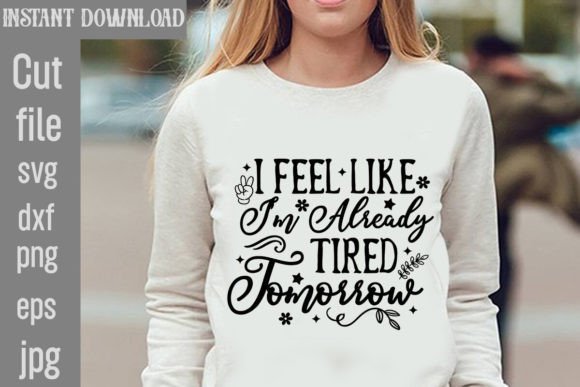
I Feel Like I’m Already Tired Tomorrow
First Impressions: A Design That Speaks Before It’s Stitched
When I opened the I Feel Like I’m Already Tired Tomorrow design, I didn’t just see text—I felt the tone instantly. It’s dry, wry, and quietly relatable—like something you’d scribble on a coffee-stained notepad at 3 p.m. on a Wednesday. The layout is clean but intentionally unpolished: slightly uneven baseline, soft weight variation in the letterforms, and subtle spacing that leans into breathability rather than rigid symmetry. As a machine embroidery design, it doesn’t scream “applique” or “satin stitch showcase”—it’s built for readability first, personality second. That makes it unusually versatile for a phrase-based graphic.
A Real-World Test: Embroidering It on a Linen-Cotton Tote Bag
Last week, I used I Feel Like I’m Already Tired Tomorrow on a natural linen-cotton blend tote for a small boutique launch. Not as a test swatch—but as the hero detail on the front pocket. I chose a matte black 40-weight thread on off-white fabric, with medium tear-away stabilizer underneath. The result? Crisp, legible, and surprisingly warm—not cold or ironic. Customers paused. Smiled. Said things like *“That’s me before my alarm goes off”* or *“My therapist sent me here.”* That reaction tells me this isn’t just a t-shirt design—it’s a quiet conversation starter, especially on everyday handmade products like tote bags, tea towels, or aprons.
Where It Shines (and Where It Needs Care)
I Feel Like I’m Already Tired Tomorrow works beautifully on stable, medium-weight fabrics: cotton sweatshirts, canvas totes, denim jackets, and structured pillow covers. Its moderate height-to-width ratio avoids awkward stretching on curved surfaces like caps—though I’d still avoid the very crown unless using a low-profile hoop and reduced stitch density. On baby onesies or lightweight tees? Proceed carefully. The lowercase “i” and tight spacing in “Tomorrow” demand at least a 3.5-inch hoop and light cutaway stabilizer to prevent puckering.
- Sweatshirt embroidery: Excellent—holds up well over fleece texture when stitch density is balanced.
- Embroidered patch: Strong candidate. Clean edges translate cleanly to heat-applied or sew-on backing.
- Baby embroidery: Use only on midweight knit (not ribbed) and confirm thread tension isn’t pulling delicate seams.
- Holiday embroidery: Surprisingly effective on cozy knit stockings or mug rugs—adds gentle humor without clashing with seasonal warmth.
Fabric & Function: What You’ll Want to Check First
This isn’t a high-contrast, bold-outline graphic—so thread color contrast matters more than usual. On dark fabric, avoid light gray or beige threads; go for charcoal, navy, or deep olive to preserve legibility. On textured or stretchy fabric (think jersey knits or slubbed linen), run a test on scrap first—especially around the descending tail of the “y” in “Tomorrow,” which can blur if stabilizer isn’t matched to fabric movement. Also note: the design includes no decorative fill stitches or dense satin borders, so it won’t overwhelm delicate items like nursery decor or embroidered kitchen towels—but it also won’t stand out from afar on oversized garments without intentional placement.
Design Assets Beyond the Stitch
The included file suite—SVG, DXF, EPS, and 300 DPI PNG—makes I Feel Like I’m Already Tired Tomorrow genuinely useful beyond embroidery. I used the SVG to build a printable mockup for an Etsy listing, then dropped the EPS into a brand board for a client’s “slow living” apparel line. As a Graphics asset, it bridges digital and physical seamlessly: same voice, consistent weight, no pixelation. That cohesion builds customer trust—especially for creative entrepreneurs who sell both finished products and printable kits.
What This Design Says About Your Brand (Even When You’re Not Trying)
Using I Feel Like I’m Already Tired Tomorrow signals authenticity—not perfection. It fits naturally in shops selling personalized gifts, small-batch apparel, or handmade home goods where emotional resonance matters more than polish. It doesn’t try to be inspirational or aspirational. It’s grounded. That honesty elevates perceived value: customers don’t just buy a tote bag—they buy recognition. And for Etsy sellers or craft fair vendors, that kind of connection translates directly to repeat buyers and word-of-mouth.
Practical Designer Notes Before You Stitch
- Test on scrap fabric—especially if using textured, dark, or stretchy materials.
- Review stitch density in your embroidery software; adjust if filling dense areas feels heavy on lightweight cloth.
- Confirm hoop size compatibility—this design reads best at 4–5 inches wide, depending on fabric drape.
- Inspect small details: the dot over the “i”, the curve of the “r” in “Tomorrow”, and spacing between “I” and “Feel” all affect rhythm and clarity.
- Try black-and-white mockups first—this design relies on tonal contrast, not color.
- Use proper stabilizer: tear-away for stable weaves, cutaway for knits, and lightweight fusible for sheer layers.
- Verify licensing terms before selling finished items—this is a digital embroidery file, not a royalty-free commercial license by default.
Final Thought: A Quietly Effective Addition to Your Design Toolkit
I Feel Like I’m Already Tired Tomorrow won’t dominate a tradeshow booth or win awards for technical complexity. But it does something rarer: it lands with sincerity, stitches cleanly, and stays memorable without shouting. For embroidery designers building real product lines—or crafters choosing their next small shop product—it’s the kind of T-Shirt Designs asset that earns repeat use, not one-off novelty. It belongs on things people hold, wear, and live with—not just display. And in a market saturated with forced positivity, that kind of honest, understated resonance? That’s worth stitching carefully.